
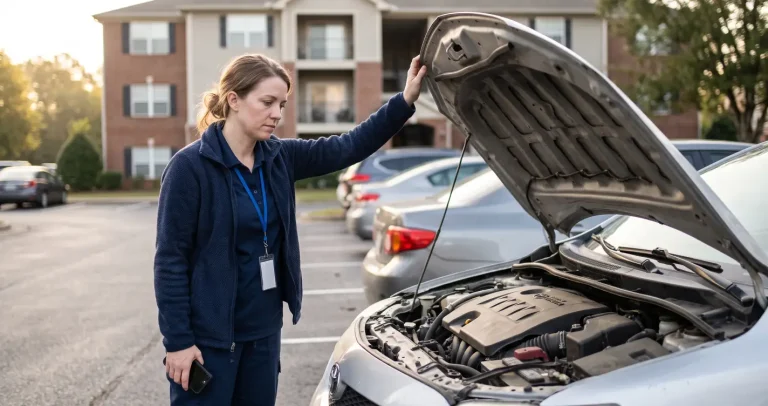
Tasha was four months into her debt snowball. Smallest balance first, extra payments, real momentum, the kind that starts to feel unstoppable. Then her car wouldn’t start one morning. The diagnosis: an $800 repair, needed within the week to keep her job.
She didn’t have it set aside. No emergency fund, no separate account, nothing between her regular budget and that repair bill. So the $800 came out of the same pool of money she’d been using to attack her debt. Four months of progress, gone in one afternoon.
The Problem Was Never Her Discipline
Tasha didn’t do anything wrong. She built a real budget and stuck to it for four straight months. What she was missing wasn’t willpower. It was a buffer between her plan and reality.
Here’s the truth about the car breakdown, the medical bill, the roof: individually, they’re unpredictable. You can’t know which month your transmission will fail. But collectively, across a year or a decade, one of them is guaranteed. If you don’t plan for ‘an’ expense, you’re planning to be blindsided by ‘the’ expense, and you just don’t know which one or when.
The Real Cost Isn’t the Dollar Amount
What actually gets destroyed when an unexpected expense hits with no cushion isn’t just the $800. It’s the momentum. Tasha had to start her snowball over from scratch. Worse, she started questioning whether the system even worked: ‘I did everything right and I’m still back at zero.’ That emotional toll is often more expensive than the repair itself.
Emergency Funds vs. Sinking Funds
This week’s insight article draws the exact distinction that would have protected Tasha’s four months of progress. Emergency funds handle expenses you cannot predict or control, the true unknowns. Sinking funds prepare for expenses you know are coming: car replacement, annual insurance, property taxes.
An $800 car repair sits right at the edge of both categories. You can’t predict exactly when it will happen, but you can predict that something like it eventually will. That’s precisely what a starter emergency fund exists to cover.
The Absorption Test
Before building any dedicated fund, ask a simple question: can I absorb this expense within my regular budget flow if it showed up this month? A $95 subscription renewal, for most people, yes, no fund needed. An $800 car repair, for most people in Stage 2, no, that needs a buffer already in place. A $20,000 car replacement in five years, that needs a dedicated sinking fund, because almost nobody can absorb that amount in a single month.
The insight article also makes an important, less obvious point: too many micro-funds spread across multiple accounts can create their own kind of stress, even triggering compensatory spending. One coaching client discovered she’d spent $600 on mobile game purchases during a month when her finances felt overly complicated and overwhelming. Simplicity isn’t just convenient, it protects you from the exact behavior you’re trying to prevent.
What This Means for Your Budget
If you’re in Stage 2 or 3 right now, working a debt snowball with no dedicated cushion, you are one unexpected expense away from exactly what happened to Tasha. Not because you’re undisciplined. Because the plan has a gap in its wall.
Your Move This Week
Start or restart your $1,000 starter emergency fund in a separate account, not mixed with checking, not mixed with anything else. This is the wall between your plan and the next surprise.
Ready to know exactly where you stand? Take the free Financial Health Assessment. It takes a few minutes and shows you which stage you’re in and what to build first.
Want help building your own cushion around your real numbers? Book a free 20-minute Discovery Call.
I’m Bryan Halverson. I help people reach their financial goals through coaching faster than they ever thought possible.